2
sentences to practice
Reflect what you heard, then ask what kind of support would help.
Your spouse, your child, your sibling, your friend has stepped back from the faith you both grew up in — or never believed at all — and you do not know what to do with that. You may feel grief. You may feel betrayed. You may be scared for them. You may be scared for your relationship. All of that is normal.
Here is what I want you to know: I have been on the inside of this experience. I left strict religion myself. I watched everyone in my life try to figure out what to do with that. Some of them handled it well. Most of them did not. The difference matters more than you think.
I am not a therapist. I offer one self-reported lived-experience perspective. If your person chooses to contact the site, the conversation is voluntary; this guide does not establish what will help every family.
Leaving a faith that runs your life is not a single decision. It is a long, painful, often invisible process. Here are some of the things that may be going on under the surface for the person you love.
They used to be active. They led the small group, taught the class, took the kids to services. Now they are quiet. They skip when they can. They go through the motions when they cannot. The faith that used to be a major part of their identity has gone silent in their life, and they may not know how to talk to you about why.
Deconstruction is not just losing a belief. It is losing a community, a story, a sense of who they were, and often a long list of relationships that were built inside that faith. Even if they are confident about leaving intellectually, the grief is real. It can look like depression. It can look like withdrawal. It is mourning, and it does not run on a schedule.
Some of the anger is at the institution that taught them what they no longer believe. Some is at people who are still pressuring them to stay or to come back. Some is at themselves for the years they were "in." If the anger comes out sideways at you and you did not earn it, that is real — and underneath it there is usually a person who is exhausted and grieving.
They might tell you they are fine. They might be functional at work, present with the kids, doing the dishes. But the inner cost can be brutal. The guilt voice they grew up with does not switch off when they leave. The 3 AM rumination is real. The loneliness is real. Often the people closest to them have no idea how heavy it actually is.
I grew up inside strict religion. I left when I could not pretend anymore, even though I did not want to. I watched the people closest to me try to figure out what to do with that — my parents, my spouse, the friends I had grown up with in the same congregation. Some of them stayed in my life. Some of them did not. None of it was simple.
During the same period, I received a bipolar diagnosis and experienced psychiatric care and serious marriage strain. I cannot establish that deconstruction caused the diagnosis, and my treatment experience does not predict anyone else's. The relevant perspective here is narrower: a belief change can affect the people around it, and their practical needs deserve direct conversation too.
What I offer is a self-reported perspective from inside one family's experience. It is not therapy, a universal script, or evidence that another family will respond the same way.
If they are deconstructing, they have already heard every apologetic argument. They grew up inside them. The questions they are asking are honest, and the worst thing you can do is treat their doubts as a problem to solve. They are not in a debate. They are grieving. Meet them there instead.
Ask what they are reading. Ask what is going on for them. Listen without immediately responding. They will read your anxiety as judgment, even if that is not what you mean. Calm curiosity is one of the most loving things you can offer.
Many people who deconstruct lose their families because the family makes the relationship contingent on belief. If the message is "we love you only if you stay," they will eventually leave the relationship too \u2014 because you taught them that your love had conditions. Choose the person, not the position.
This is hard for you too. You may be grieving the version of the relationship you thought you had. You may be questioning your own faith. You may be exhausted from holding it together. Find your own support \u2014 a therapist, a friend, a community of other people whose loved ones have walked this road. You matter in this too.
Start with "I love you and I am not going anywhere." Then listen. Do not argue. Do not try to fix it. Do not quote scripture. They have heard every apologetic argument already — they grew up inside them. What they need from you is not answers. It is a relationship that does not depend on them believing the same things you do.
Do not say "you just need to pray harder." Do not say "the devil is deceiving you." Do not say "you are just going through a phase." Do not make the relationship conditional on them coming back to the faith. When you say things like that, they do not hear concern — they hear that your love for them only works inside a specific belief system. That pushes them further away.
Maybe. Maybe not. No one can promise you either outcome. What I have seen is that the people who feel loved regardless of their beliefs often stay in relationship — and sometimes their spiritual path evolves in ways nobody expected. But if you make your relationship with them contingent on them returning, you risk losing both the belief and the person. Choose the person.
This is hard for you too. You may be grieving the future you imagined. You may be questioning your own faith because of what you are watching. Find your own support — a therapist, a friend, a community of others whose loved ones have walked this road. You cannot pour from an empty cup. Taking care of yourself is part of showing up for them.
If every conversation turns into a fight, step back. If you cannot talk without making it about faith, step back. Let them know the door is open and then give them space. Being a safe person does not mean being in their face about it. Sometimes the best thing you can do is let them know you are there and then let them come to you when they are ready.
If they are open to it, send them this site. Let them read it on their own terms. If they decide to reach out, I will sit with whatever they want to talk about — no pressure, no agenda. And if you need to talk first about what you are watching them go through, you can reach out too. This is hard from both sides. I get that.
Send them this site. Let them read it on their own terms. If they decide to reach out, I will sit with whatever they want to talk about. No pressure, no agenda. And if you need to talk first — about what you are watching them go through — you can reach out too.
Pause, look, and use something
Long explanations are easier to use when they are interrupted by evidence, a visual reset, a decision, and a tool. This section turns the topic into a private action plan without presenting generated media as a real person, place, or testimonial.
4
Original visual directions attached to this topic; not claimed as documentary evidence.
3
Topic-specific ideas plus links to an independent curated resource library.
0
The check-in below is private and does not pretend to represent other visitors.

Quick perspective
A page can be long and still feel thin when every paragraph asks the reader to do the same thing. Useful depth comes from different jobs: explain, show, compare, help decide, and make the next action easier.
Questions this page can turn into content
Watch from a named source
Videos and readings for understanding religious trauma without treating a web page as diagnosis.
Recovering from Religion resource library ↗
A sourced collection for examining belief changes, uncertainty, and life after certainty.
Recovering from Religion resource library ↗
Private check-in
Nothing is submitted. This page does not invent vote counts or claim that other visitors answered.
Readiness tool
0 of 4 foundations in place
Choose the statements that are already true for you.
This planning aid is not a safety, legal, medical, or clinical assessment.
Family response guide · Reviewed August 2026
When someone changes belief, the first useful family response is often to listen, reduce pressure, ask what support is wanted, and keep practical connection intact. Do not diagnose, threaten, expose, monitor, or force a doctrinal debate. Safety concerns deserve appropriate local professional or emergency support.
2
Reflect what you heard, then ask what kind of support would help.
0
A relationship conversation should not become an interrogation or conversion campaign.
1
A specific time to reconnect is more useful than “call if you need anything.”
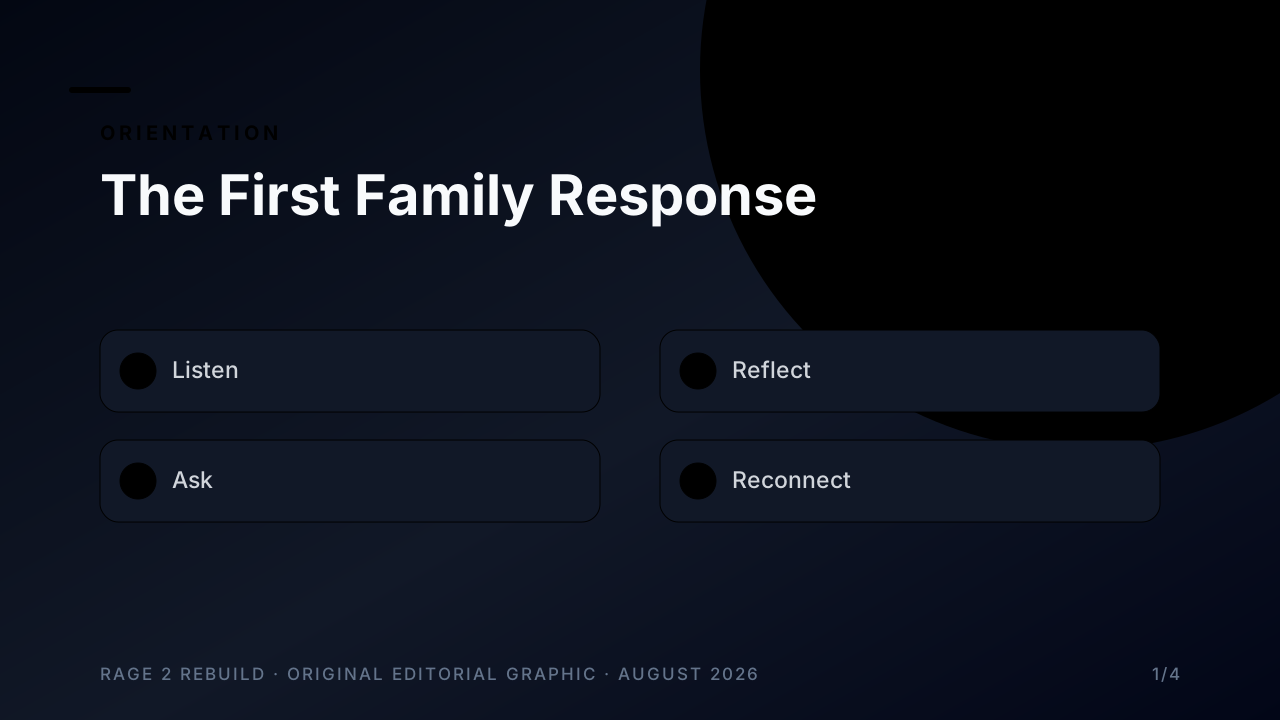
Orientation
A conversation sequence that protects agency.

Evidence
Family contact can support more than agreement.
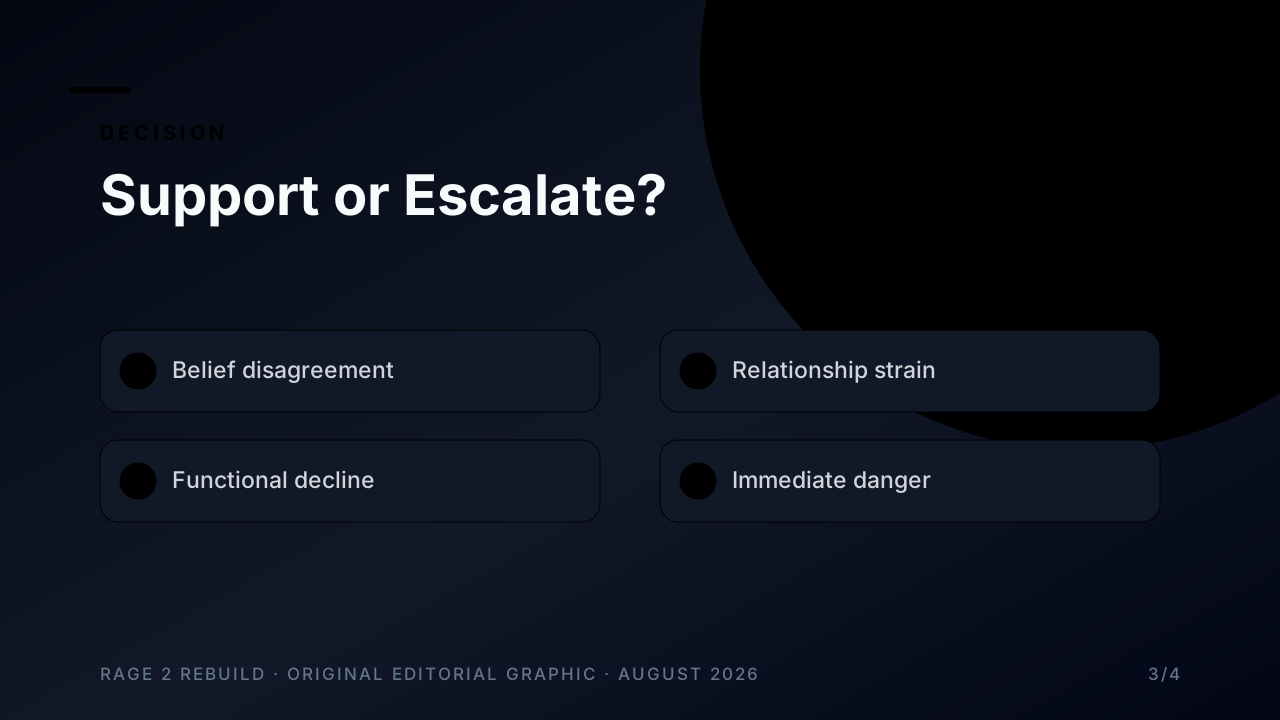
Decision
Match the response to actual risk.

Action
Keep the door open without pressure.
Browser-only planning tool
Choose relationship goals that remain possible even when agreement is not.
Original page video
Your first response can protect the relationship even when you disagree with every conclusion.
Synthetic narration and original editorial graphics. No client, therapist, religious group, or documented event is depicted.
Private check-in
Nothing is submitted. This page does not invent vote counts or claim that other visitors answered.
Readiness tool
0 of 4 foundations in place
Choose the statements that are already true for you.
This planning aid is not a safety, legal, medical, or clinical assessment.
Named sources
U.S. Surgeon General
Framework for understanding the structure, function, and quality of social connection.
National Institute of Mental Health
Official U.S. guidance on finding care and responding to immediate danger.
Recovering from Religion
Named external support option; verify its current hours, privacy terms, and service scope directly.
Editorial review: August 1, 2026. Hours, laws, credentials, costs, services, and availability can change; verify them directly.