8
governance questions
Purpose, leaders, privacy, moderation, money, complaints, safety, and referrals need written answers.
A deconstruction or mental-health resource can feel personal. Before sending one, ask whether the person wants it. Do not diagnose them, announce their beliefs, or turn a private conversation into a referral without consent.
Share one relevant page, describe its limits, and leave the decision with the recipient. The content is educational and cannot promise a result, replace professional care, or determine whether someone is safe.
Sharing can reduce the work of finding a relevant page, but it can also feel like judgment or surveillance. Permission and context matter more than sending as many links as possible.
Rage 2 Rebuild includes Elder X's self-reported lived experience, planning tools, and external sources. It does not establish that his choices caused recovery or will help another person in the same way.
A respectful offer sounds like: “I found a non-clinical planning page that may relate to what you mentioned. Would you like the link?” Care includes accepting no, protecting privacy, and using emergency or professional routes when a website is not the right tool.
Ask whether the person wants a resource. If yes, send one page that matches the question they raised and state that it is educational, not therapy or crisis care.
Explain that the Daily Protocol is a seven-day planning experiment, not a cure or mandatory routine. Invite the person to ignore any step that is unsafe, inaccessible, or inappropriate for them.
If you describe your own experience, label it as your experience. Avoid “this will work for you,” treatment comparisons, or claims that one outcome proves the advice is effective.
Share a public page without tagging a person or revealing their beliefs, diagnosis, family conflict, or crisis. A resource can be public while someone else’s situation remains private.
Print a checklist only for yourself or with the recipient’s permission. Do not place material in someone’s private space, vehicle, workplace, or home without consent.
No verified Rage 2 Rebuild chapter or matching program is currently listed. If you invite someone to an independent group, disclose who runs it, where it meets, fees, privacy rules, moderation, and whether it has any professional credentials.
If you have ideas for how to spread the word, if you want to help, or if you just want to tell me how the protocol is working for you — reach out. Messages are reviewed when capacity allows; response timing varies.
Ask first: “Would it help if I sent one planning guide that relates to what you mentioned?” If they say no or do not answer, do not keep sending material.
Describe the page, not the person: “This is a non-clinical checklist about family conversations.” Do not label their condition, religion, risk, or treatment need.
The public pages, browser-only check-ins, and contact form do not charge a fee. A separate paid conversation outline may exist and requires confirmed terms before payment.
Do not publicly tag or expose someone’s religious or mental-health situation without permission. Anonymous mass sharing is different from implying that a specific person needs help.
No operating chapter program is currently verified. Do not use the brand or collect members, money, or sensitive information as an official chapter. You may send an idea through the contact form for future review.
Ask first, send one relevant page, state that it is educational, and do not expose someone's beliefs or mental-health situation to other people.
If immediate safety is at risk, sharing a content page is not enough. Use the person's current local emergency or crisis route.
Pause, look, and use something
Long explanations are easier to use when they are interrupted by evidence, a visual reset, a decision, and a tool. This section turns the topic into a private action plan without presenting generated media as a real person, place, or testimonial.
4
Original visual directions attached to this topic; not claimed as documentary evidence.
3
Topic-specific ideas plus links to an independent curated resource library.
0
The check-in below is private and does not pretend to represent other visitors.

Quick perspective
A page can be long and still feel thin when every paragraph asks the reader to do the same thing. Useful depth comes from different jobs: explain, show, compare, help decide, and make the next action easier.
Questions this page can turn into content
Watch from a named source
Videos and readings for understanding religious trauma without treating a web page as diagnosis.
Recovering from Religion resource library ↗
A sourced collection for examining belief changes, uncertainty, and life after certainty.
Recovering from Religion resource library ↗
Private check-in
Nothing is submitted. This page does not invent vote counts or claim that other visitors answered.
Readiness tool
0 of 4 foundations in place
Choose the statements that are already true for you.
This planning aid is not a safety, legal, medical, or clinical assessment.
Group governance · Reviewed August 2026
No verified operating Rage 2 Rebuild chapter program is currently offered. Do not collect members, money, sensitive disclosures, or brand authority as an official chapter. A future peer group would need a defined purpose, accountable leadership, privacy limits, moderation, complaints, financial transparency, safeguarding, and referral procedures.
8
Purpose, leaders, privacy, moderation, money, complaints, safety, and referrals need written answers.
0
The public site does not currently substantiate an operating chapter network.
1
Test a bounded activity before creating identity, dues, or authority.
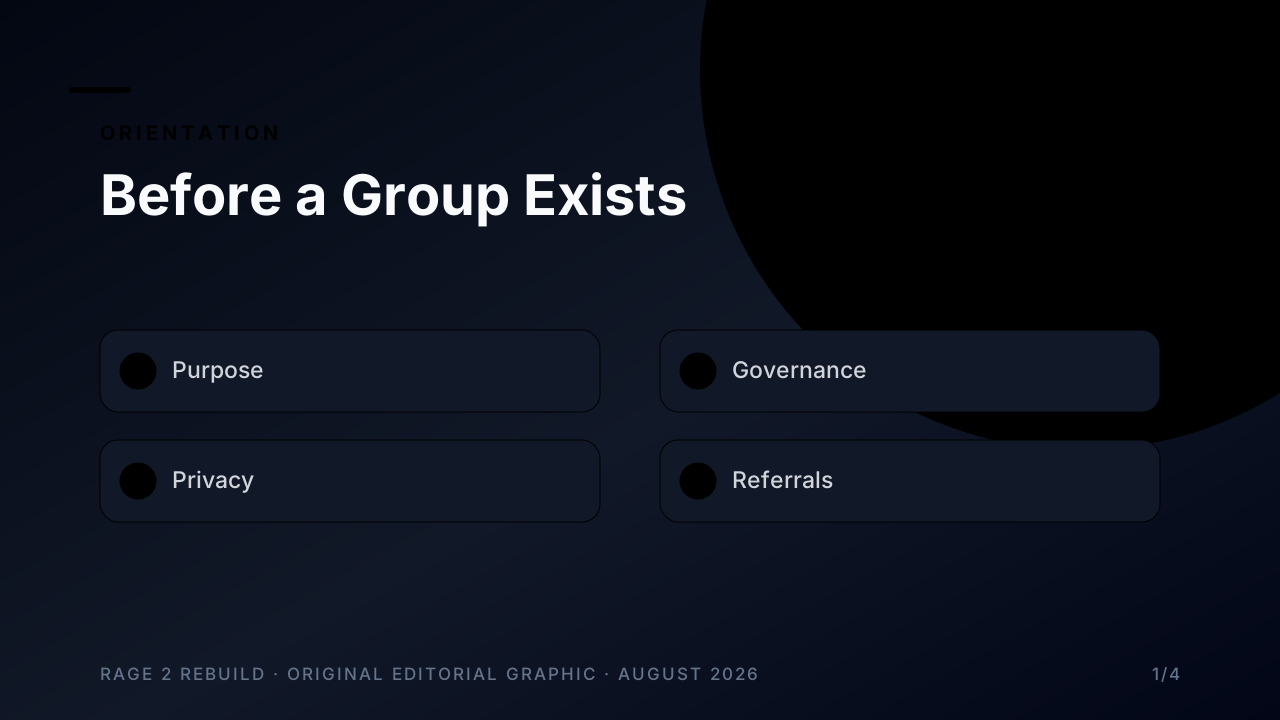
Orientation
Foundations come before recruitment.
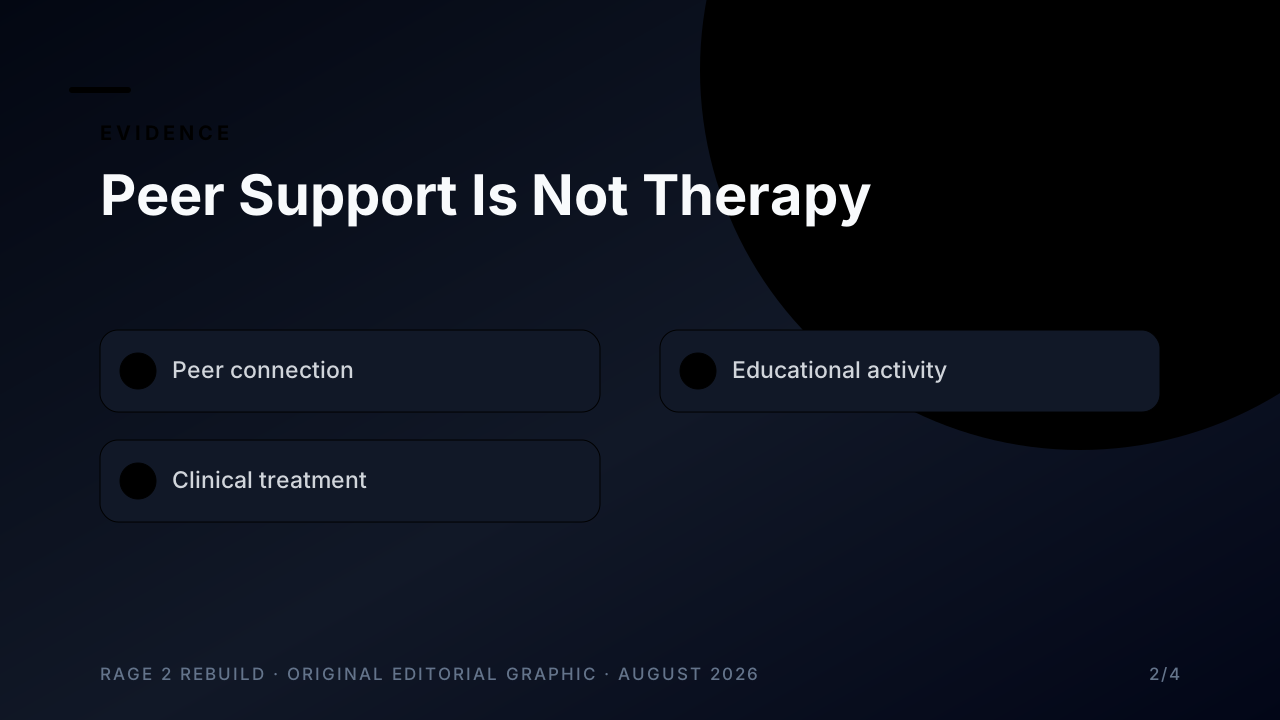
Evidence
Represent the role and credentials accurately.
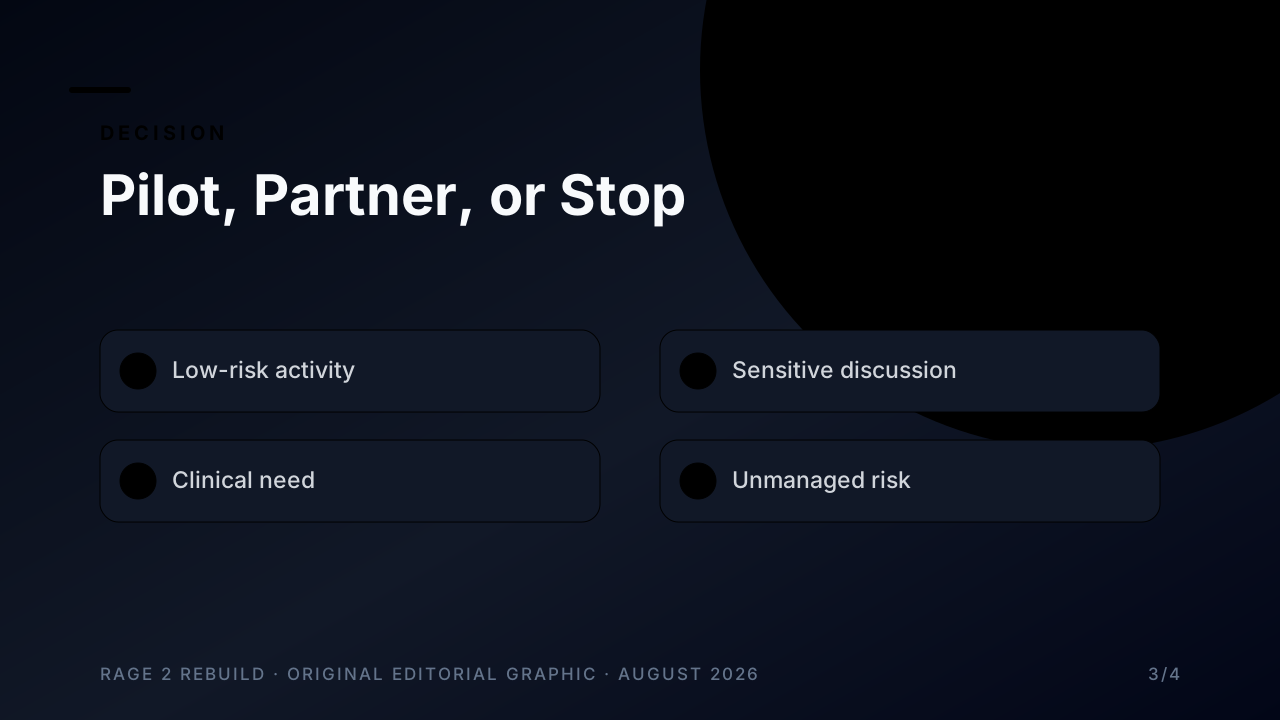
Decision
Scope and risk determine the structure.
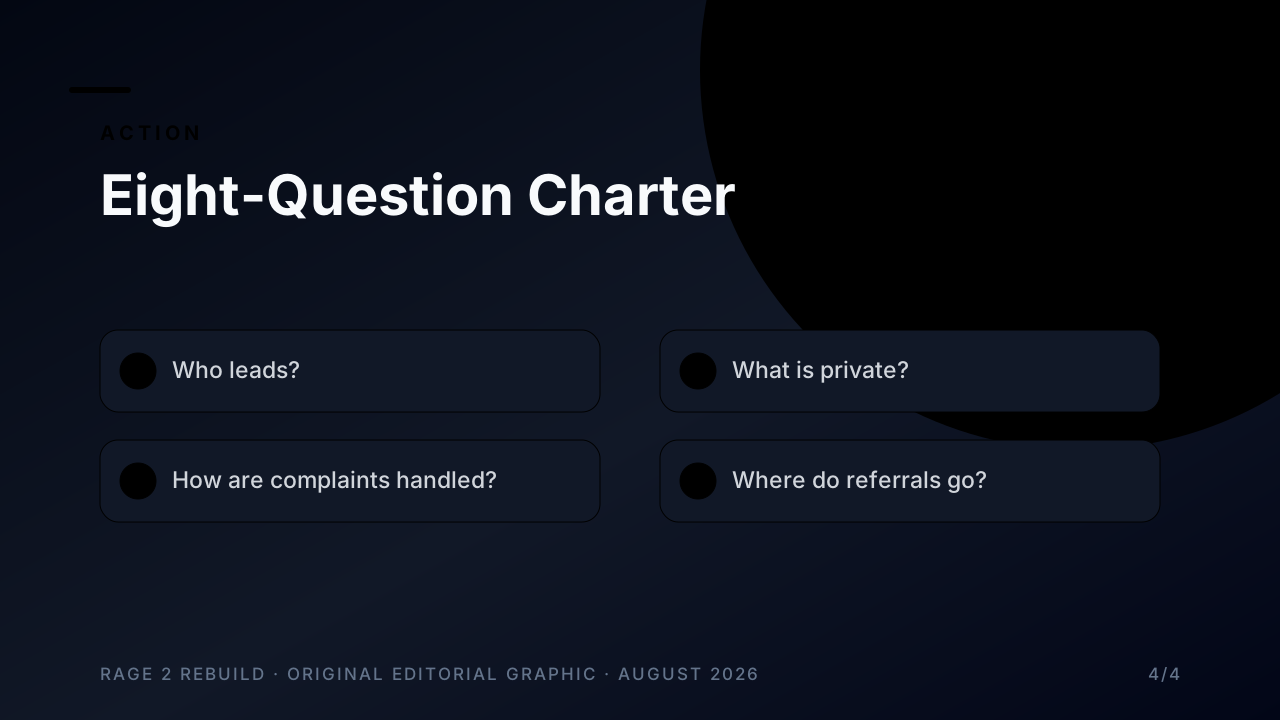
Action
Write the operating rules before inviting participants.
Browser-only planning tool
Begin with a defined activity and explicit limits rather than a movement.
Original page video
A logo and a meeting place do not make a safe community. Governance has to come first.
Synthetic narration and original editorial graphics. No client, therapist, religious group, or documented event is depicted.
Private check-in
Nothing is submitted. This page does not invent vote counts or claim that other visitors answered.
Readiness tool
0 of 4 foundations in place
Choose the statements that are already true for you.
This planning aid is not a safety, legal, medical, or clinical assessment.
Named sources
U.S. Surgeon General
Framework for understanding the structure, function, and quality of social connection.
SAMHSA
Official U.S. treatment and support routes; local availability and eligibility must be confirmed.
Recovering from Religion
Named external support option; verify its current hours, privacy terms, and service scope directly.
Editorial review: August 1, 2026. Hours, laws, credentials, costs, services, and availability can change; verify them directly.